Dental Practice Solutions
Schedule My Opportunity Call Call us now (623) 252-1941 Client login
  • Home
  • About
    • About Us
    • Testimonials
    • Videos
  • Services
    • Hire a Dental Hygienist
    • Dental Hygiene MAX Course
    • 6-Month Dental Hygiene Department Optimization
    • 12- Month Dental Hygiene Department Training
    • Dental Hygiene Department / Team Workshop
  • E-Learning
    • Free Resources
      • BOOST CASE ACCEPTANCE eBook
      • Treating the Gingivitis Patient
    • More Courses
      • Oral Inflammation and Systemic Vitality
      • Properly Sequence Hygiene Appointments
      • Alzheimer’s Disease Prevention.
  • Webinar
    • Current Webinar
    • Power Hour March 15 2024
  • Blog
    • Podcasts
  • Contact Us

Clackamas Dental Consultant | 4 Tips for More Productive Employees

By: admin

January 23, 2018

Research has shown time and again that happiness plays a large role in the productivity of employees. For example, a study conducted by Google saw a 37% increase in productivity as a result of initiatives focused on improving employee morale. Financial incentives alone are often not enough to boost employee performance, as our brains are hardwired to respond to positivity.

Here are 5 simple tips you can follow to help improve happiness in your team. For more solutions for running a more productive practice, contact our firm today!

  1. Give recognition where it’s due. Employees that feel valued are more likely feel happy about their work. Take time to recognize positive contributions of the team. Not only will this make the recognized employee feel proud of their work, it can also incentivize others to work harder to achieve the same praise.
  2. Get them invested. It’s most likely the case that financial gain was not your sole reason for starting your business. Maybe you’ve had a lifelong passion for helping others. Maybe you’ve always been fascinated with the science of dentistry. Whatever those reasons were, share them with your team! Knowing that they’re contributing to something bigger can help employees take pride in the work they do, no matter their role.
  3. Set clearer goals. When your employees don’t have a clear expectation of their role, it can be difficult for them to recognize whether or not they are performing well and lead to increased stress about their work. By setting clearer expectations of your employees and goals for your business as a whole, your employees will have a standard to judge their work against, and therefore be able to feel better about good performance.
  4. Promote from within when possible. A common concern of employees is a fear that they won’t be able to grow in their current jobs. By establishing a culture of development and promotion from within the company, you’re clearly communicating to your employees that you want them to see your office as a long-term home, not just another job.

Studies indicate that US companies lose about $500 billion annually due to loss of productivity caused by unhappiness at work. Don’t let your team be a part of this problem. If you’re looking for additional strategies for running a happier, more productive office, contact our firm today!

Posted in Blog, Dental Hygiene Patients, Marketing, Practice Management Consulting

Dental Consultant | Don’t Discredit Your Value

By: admin

January 2, 2018

Many people may not recognize the value that their dental provider brings to their lives. From the improved confidence that comes with a straighter, brighter smile to the life-saving benefits of regular dental care, you have the opportunity to make a profound difference in the lives of your patients. Finding ways to help patients recognize the value you offer will also help them recognize the importance of dental care and can turn your patients into raving fans. Below are some tips that can help patients better understand your value.

Build awareness of the dental solutions you offer.
Often, the reason patients fail to seek treatment from their dentist is simply a lack of information about available options. For example, if they don’t know you treat sleep apnea, they’ll never think to ask you about it. Make it easier for patients to learn about your offered services. Whether you do this through your website, printed materials, or simply by talking to them, this will be the most effective first step in opening the door to growth.

Be proud of your credentials.
People often fail to realize just how much work goes into becoming a dentist. From undergrad and dental school to continuing education, you should showcase your expertise. You can do this by hanging your diploma on the wall or by posting videos online about continuing education.

Build a connection.
Get to know your patients and what’s going on in their lives. This will show that you don’t just see them as another mouth to treat. These relationships will make your practice stand out in your patients’ minds and keep them coming back with referrals.

If you are having trouble maintaining patients or have low new patient numbers, an undervaluing of your service could be the problem. A simple way to begin resolving this is through building relationships with your patients and clearly explaining the expertise and solutions you offer.

For more guidance on how to share your value with current and potential patients, contact us today!

Posted in Dental Hygiene Patients, Uncategorized

HOW TO SPOT AN OROFACIAL MYOFUNCTIONAL DISORDER DURING THE HYGIENE VISIT; Five signs to look for that could change a life

By: admin

December 13, 2017

Have you noticed that some patients tend to have more lunch stuck on their teeth then others?

You know the patient that comes in and apologizes for eating on the way to her appointment. You tell her that it is fine, that you are just glad she had lunch. When she opens her mouth, you are shocked.  It appears that the entire bagel is still in her mouth, smashed up against her teeth.  How is that possible?

Then there is the 60-year old man that instantly falls asleep when you lean the chair back and starts snoring just as you are going to give him an injection. How about the cute little six-year old girl that has a speech impediment, or the five-year old boy with an overjet and long skinny face with dark circles under his eyes.

You may have thought that the lady with the bagel mouth was just not kind enough to clean up before her appointment, and left you to do it for her.  Well, it is very likely that she has an ankylosed tongue that does not allow her tongue to reach up high enough to clean food debris off of her teeth.

It may be obvious to you right away that the 60-year old man is suffering from sleep apnea, but did you know that is could be due to his tongue not being able to reach up to the roof of his mouth. It is literally blocking his airway at night because it rests on the floor of this mouth.

That cute little six-year old girl hasn’t been able to develop proper speech patterns due to a tongue thrust.  And you got it, the five-year old boy is a thumb sucker. These are all signs of an Orofacial Myofunctional Disorder (OMD).

HOW TO SCREEN FOR OROFACIAL MYOFUNCTIONAL DISORDERS

Dentists and hygienists are in a prime position to screen for Orofacial Myofunctional Disorders. There are several signs we can screen for to determine if the patient may have a disorder and benefit from seeing a trained therapist. The following are some of the most commons signs:

Upper or Lower Lip Frenum Restriction

Jaw Pain or Clicking/Popping

Mouth Breathing

Sleep Apnea

Snoring

Ankyloglossia (tongue tie)

Forward Head Posture

Neck Pain

Enlarged Tonsils/Adenoids

Acid Reflex

Narrow Palate or Crooked Teeth

ADHD

If you are new to learning about OMT, keep it simple by starting with these five signs and symptoms:

Ankyloglossia

Commonly referred to as “tongue-tie” occurs when the lingual frenulum is too short to allow for normal tongue movements. Best if done with the patient in an upright position. Have the patient open wide and lift his tongue to the roof of his mouth.  Determine is he is able to reach his tongue up to his incisive papilla easily or if he struggles.  Then have him stick his tongue straight out, if the tip appears heart shaped, this is a sign that he is tongue tied. The heart shape apex happens when the frenum is short and pulls down the center of the tongue.

Low tongue rest posture

Think mouth breather.  When nasal breathing is impaired, the jaw drops and the tongue rests low and forward in the mouth in order to open the airway for breathing. It may be that nasal breathing is not impaired, but mouth breathing has become a habit. Watch for your patients resting position. Is the mouth open? Is he breathing out of his mouth or nose?

Tongue Thrust

Tongue thrust is in which the anterior surface of the tongue makes repeated contact with any of the anterior teeth, or protrudes between the arches. Have the patient swallow for you while you are holding his bottom lip. If he has a tongue thrust he may have a very hard time swallowing. He may need to pull the lower lip out of your hand in order to complete the swallow. In a healthy swallow, the tongue rests in the palate, the teeth come together, and then the person swallows. The facial muscle should not move, so any lip puckering or licking of the lips before swallowing should be warning signs of tongue thrust. Another sign will be an anterior open bite.

Sleep Apnea

When you place a patient in the supine position and he immediately falls asleep and starts to snore, this is a sign that he may have sleep apnea or other conditions keeping him up at night. Luckily for us trying to get work done, this does not happen very often. In most cases you will need to question the patient. You will often get the response of “my wife tells me I snore, but I don’t know”.  If nothing else, this is an opportunity for them to become mindful of possible snoring and to question their spouse or use a sleeping app to record their sleeping patterns and sounds. Referring the patient to have a sleep study or consult with his medical doctor is a good place to start.

Digit Sucking

Although there are adults that suck their thumb, odds are that most of your thumb sucking patients will be children. It may be an easy screening if you see the child suck his thumb, but often they will not do it in public and you will have to look for signs and question the parents.  Look for an anterior open bite and a swollen nub on the patients thumb or fingers.  One reason a child may suck his thumb at night is to help open his airway so he can breathe. If he has a tongue tie he may be using a digit to press the tongue down out of the way. Resting the tongue on the incisive papilla area is also soothing and if his habit is hold the tongue down, he is missing out on this natural soothing technique. OMT specialists have ways to help break the child of this habit and can help with underlying causes.

WHAT IS OROFACIAL MYOFUNCTIONAL THERAPY

Orofacial Myofunctional Therapy (OMT) is the neuromuscular re-education or re-patterning of the oral and facial muscles. It is the establishment of correct functional activities of the tongue, lips and jaw, so that normal growth and development may progress in a stable, homeostatic environment. OMT specialists obtain training in this field in order to work with patients to correct disorders that are affecting their well-being. Think physical therapy for the mouth.

HOW TO BECOME A TRAINED OROLFACIAL MYOFUNCTIONAL THERAPIST

Orofacial Myofunctional Therapists include dentists, dental hygienists, speech pathologists and occupational therapists. Although OMT may be in the scope of our license, further training is required in order to properly treat patients. Training opportunities for those interested in learning more about Myofunctional Therapy include private mentoring from a current Myofunctional Therapist, courses through academies or associations, or information learned within the educational curriculum.

CONCLUSION

Proper treatment of OMD’s require a collaboration of dental and medical professionals. By being aware of the signs for these disorders, you are able to provide a screening for potential issues and refer them to seek treatment with a trained OMT. When you become aware of OMD’s you will start to see them everywhere- maybe even in the mirror.


References:

International Association of Orofacial Myology- www.iaom.com

Academy of Orofacial Myofunctional Therapy- www.aomtinfo.org

Academy of Applied Myofunctional Sciences- www.aamsinfo.org

American Speech-Language-Hearing Association- www.asha.org

Cindy Rogers, RDH, BS, OMT is the lead hygiene advisor for Dental Practice Solutions. She started in dentistry as the front desk girl in 1998, and has since been a business leader, dental hygienist, writer and untiring advocate of Orofacial Myofunctional Therapy.

Posted in Blog

The Dental Hygienists Role in Keeping Doctor’s Schedule Full

By: admin

December 6, 2017

Every success schedule in the dental office begins with a strategy. Without a strategic plan, you are not able to meet the financial goals to keep your dental practice surviving.

The best plan is to not survive, but thrive.

What is the dental hygienist’s role in keeping doctor’s schedule full?

1st Step to Doctor’s Success Schedule

The first step for hygienists to help keep doctors schedule full is to have a mindset that they are like an associate to doctor; helping the practice to grow.

2nd Step to Successful Scheduling

The next step is actually two-pronged. The hygienist needs to audit all patient records before their day at the office begins. This audit serves many purposes but for this blog we will stick to the topic of what a hygienist’s role is for successful scheduling and helping doctor’s schedule stay full all day.

When auditing the patient’s records look to see what outstanding treatment is necessary. Why does the patient need to schedule this? What is the urgency the hygienist and all the clinicians will speak to this patient about?

For example: Does the patient have a dark spot on their bite-wing x-ray and when you audit the patients record you feel concerned they may very soon have a toothache.

Why did this patient not want to schedule this appointment? It is important to understand the patient’s objection so that when the hygienist has the patient in their chair they can immediately address the patient’s previous objection.

Example: Without even saying; “I know money is a concern,” what you can say is (Have the patient seated upright in the chair with x-rays, and/or intra-oral photos there in front of the patient), “Mrs. Jones, doctor and I are both concerned about this black spot on your x-ray. Let me show you this area. Do you see this black spot? Here is the nerve of your tooth and as you can see this black spot is very close to the nerve which means that once it reaches the nerve it will cause a toothache and also means we probably need to do a root canal and a tooth with a root canal needs a tooth. This means spending a lot more money to keep this tooth.”

Notice how the hygienist in this example address the patients concern before they could even give their objection which they stated at their last appointment and this is the reason the treatment is unscheduled.

It is also very important that hygienists not only think about the gum health of their patients but provide a visual exam.

After the hygienist completes all of their screenings, it is a great time to sit the patient upright in the chair and show them what you see. Look together with the patient. Make the patient part of this process. This means that you look together and ask the patient if they see what you see.

Use words that the patient understands. Saying words like “periodontal disease,” and “tooth decay” probably don’t mean as much to your patient as if the words: gum infection, inflammation, active disease, cavity, black soft spot, etc.”

When you see holes in doctor’s schedule it’s time to take a look at the hygiene patient exam process. It’s a great time to look at patient records who have not scheduled their appointment and discuss as a team what you can do differently so these patients will schedule and pay.

The best way to get patients scheduled and paying for the care you offer is to communicate (your words and actions) in a way that helps the patient to feel and believe they want what they need.

Many of your patients have left your office without committing to schedule and pay for your care. Many of these patients also took very nice vacations this summer, they already plan to buy that new iPhone X, some have spent a lot of money on a really nice car and many have spent thousands of dollars on a sleeve of body of tattoo’s.

Our job? We have a responsibility to help our patients want what they need. Don’t most people want to live a longer and healthier life? This is our overarching message, “Optimal oral health will help you live a longer and healthier life!”

Still have holes in your schedule? Please feel free to reach out to an expert. This is one area that we have created a success strategy around. Our client offices have many patients who now schedule and pay for treatment AND many of their patients pay before their treatment is complete.

Our client offices have a system in place for big cases where patients are currently paying in advance for doctor and hygienist’s services.

Most of the medical cosmetic offices have patients pay in advance and why can’t your patients feel urgency to pay for keeping a healthy mouth?!

It’s all in how you are delivering your message to the patient in your chair.

Debbie Seidel-Bittke, RDH, BS is a dental consultant, coach, speaker and author. She is also CEO of Dental Hygiene Solutions, powered by Dental Practice Solutions. Debbie is a world-class leader in creating profitable hygiene departments. She is well-known as a former clinical assistant professor at USC in Los Angeles and a former hygiene department program director. Dentistry Today recognizes Debbie as a Leader in Dental Consulting.

DENTISTRY TODAY considers her a top dental consultant for the past 16 yrs.

The focus of Dental Practice Solutions is to create healthier, longer lives for your patients while supporting the practice to optimize their hygiene department. The team at Dental Practice Solutions, takes an integrative approach with your team to create an increase in your production and collections without working harder. When you continue to use the systems implemented, you will benefit from production that creates dividends year after year, for the life of your dental practice.

Debbie is also a former Hygiene Program Director and clinical assistant professor for the dental hygiene program at USC in Los Angeles.

Debbie is passionate about supporting dental teams to provide a profitable, patient-centered dental practice through improving systems and efficiencies in the dental hygiene department

Posted in Blog

Your Dental Practice Profitability Compass

By: admin

November 29, 2017

How much time did you spend planning your last vacation?

Did you map it out?

Or, did you just throw some clothes in a suitcase and take-off in your car headed in what you thought was the quickest path to your destination?

I bet that you took many hours to plan your last vacation and you started packing probably the week before you left.

In today’s world of technology, you pulled up your map using your mobile device and maybe you printed the directions on your laser printer.

How much time do you spent planning your day at the dental office?

Does your team have a practice profitability compass?

Your Compass

The compass we provide our clients is what you probably know as a “team huddle.”

Once you have this system in place, it should take about ten minutes to plan your day.

The entire team will audit their area of expertise.

Here are a few suggestions to organize your team huddle:

  1. Begin with the financial coordinator (Office manager or similar position) reporting on production/ collections: Monthly goal and your current month-to-date production/collections. Talk about what went well the previous day and what did not go well, etc.
  2. Scheduling coordinator reports on open holes in today schedule and in the near future. Let the team know about ER patient availability. Provide doctor with a list of new patients for him/her to call before their 1st (Yes! This is something different and you will stand out among other dentists in your community if you do this one thing!)
  3. Hygienists come to this meeting with an understanding and communicate to the team about which patients need: new medical history, Oral ID™ FMX/BWX, doctor exam, perio charting, outstanding restorative needs, family members who also need a hygiene appointment or restorative care, post-op call update (For all patients who received local anesthesia), etc.
  4. Assistants audit their schedule to share and inquire about patients with special needs, local anesthetic needed, type of impression needed, results of post-op calls from the day before, which patients have family members who need a hygiene or restorative appointment, etc.
  5. Yes, even doctor has a part in the morning team huddle. We suggest that our doctor call all new patients scheduled during the week prior to their 1st appointment. Doctor will report on the outcome of this quick call to welcome the new patient.

When everyone takes time to look at their schedule and review their patient needs as listed above, you will discover adjunctive and necessary services your scheduled patients and their family members need.

When you look at your practice profitability compass you can work together as a team to close various gaps in meeting your goals. You will also be able to serve your patients at a much higher level.

Closing the Gaps

Maybe you are still scratching your head. Some of you think meetings are a waste of time.

What I am suggesting is that everyone let the team know what is needed to make the day profitable, efficient and provides the best care for the patients.

Your morning team huddle will help navigate your day and eliminate any un-necessary bottlenecks which might occur.

This compass is what makes a day that has a smooth landing without turbulence.


Debbie Seidel-Bittke, RDH, BS is a dental consultant, coach, speaker and author. She is also CEO of Dental Practice Solutions. Debbie is a world-class leader in creating profitable hygiene departments. She is well-known as a former clinical assistant professor at USC in Los Angeles and a former hygiene department program director. Dentistry Today recognizes Debbie as a Leader in Dental Consulting.

Be sure to grab this free 3-part hygiene video department training, webinar on the Gingivitis Code plus flowchart on training the patient with gingivitis and Strategic Planning Session: http://www.dentalhygiene.solutions/

You can reach Dental Practice Solutions to schedule a complimentary strategic planning session by calling 949-351-8741 or you can send an email to: admin@dentalpracticesollutions.com

You can also go to the website: www.https://dentalpracticesolutions.com

Posted in Blog

More compliance. Less defiance. Innovative model for case acceptance by patients…the path of least resistance.

By: admin

November 22, 2017

By Steven Ury, DDS, Periodontist
      Randy Nolf, DDS, Periodontist

Dentists and hygienists are using a simple to complete analytical software making discussions with the patients easier…making the progression to treatment compliance easier… and enabling a practice to substantially increase case acceptance for periodontal therapy. This technology makes available a single language, with everyone “on the same page”, to discuss periodontal disease, and the necessary treatment.

The software allows for thoughtful and readily understandable discussions with patients thus improving the progression to treatment acceptance through a path of least resistance.

Implementing innovative technology into the practice, using risk and disease severity health scores as clinical support, will no doubt increase patient compliance.

PreViser™ Corporation www.PreViser.com provides their web enabled Oral Health Information Suite (OHIS) software for free. The use of the technology provides three (3) numbers, or scores, indicating patients’ risk of future periodontal disease, existing disease state and their ongoing oral health stability. With these 3 scores, patients then have a clearer idea of the severity and comprehensiveness of their problems. In other words, they know how things are going.

A nice feature of the OHIS is that it allows practitioners to recalculate the risk scores, just as if the patients had completed the advised treatment. So, a patient can visualize what will happen without treatment compared to what will occur with the recommended care. That’s when the fun begins. These scores predict whether the treatment plan will be working. Outcomes are the key.

Dental practices are utilizing this powerful method to impact a patient’s decision to proceed with care for a lifetime of oral health. Case acceptance is markedly improved providing more treatment for periodontal disease by the dentists and hygienists including any necessary subsequent restorative care.

Why now? Well, there’s a new sheriff in town. Patients and practitioners, as well as insurance companies and employers, are relying less on subjective findings to determine if periodontal care is working.  Welcome the new law of the land – objective findings derived by an analytical software. Practitioners are accurately communicating with patients about their risk of disease and the outcomes of treatment. Everyone’s “on the same page”. We’re talking Evidence Based Practice here; the integration of clinical expertise, patient values, and the best research evidence into the decision-making process for patient care.

Instead of dentists and hygienists potentially disconnecting on a diagnosis, a treatment plan or a prognosis, they can agree and provide an easy to use, objective and reproducible way to measure, understand and communicate patients’ risk and disease level as simple numeric scores.

People relate to scores and knowing their numbers gets them involved. Physicians supply blood pressure, cholesterol, and diabetes numbers to their patients to follow their progress. Now dental patients will know their periodontal disease scores and look for improvement in the numbers.

More and more dentists in the know are advocating the principles of a medical model of healthcare for dentistry. Less repair and more interception and prevention. Consider the PerioCentric™ practice, defined as a best practice in which treatment revolves around sound periodontal diagnosis and treatment, utilizing metrics to evaluate treatment outcome.  It employs a simple step by step, reproducible, algorithmic approach to care we call the PerioBlueprint™.

When implemented it provides dental professionals the knowledge and tools to discover undiagnosed and untreated periodontal disease in an existing practice. The appropriate care for these conditions will result in improved health for patients as well as production and revenue for the dental practice that may prove to increase exponentially.

Dentistry is adjusting to a new paradigm that is better for patients by shifting focus away from procedures for repair of disease… to a model of interception and prevention of disease.

There is unprecedented demand for increased care for periodontal disease. The most recent data from the Center for Disease Control revealed that 47.2% of adult Americans exhibit periodontal disease and the disease increases to 70.1% of adults over 65 years. Contemporaneous insurance company data reports only about 7% obtain periodontal treatment…Only 7%.

Dentistry has a busyness problem. Nationally, approximately 1 in 3 dentists say they are not busy enough. Imagine the increase in production and revenue when discovering that perhaps 50% of patients require some form of periodontal care. And not just code 1110 “prophy” care – we’re talking anesthetized scaling/root planing, pocket reduction and tissue grafting surgery. LANAP, and more. Of course, when maintenance starts, using the obligatory code 4910 will result in more comprehensive visit than a code 1110 “cleaning” and thus, improve hygiene production.

We are in a time of transformational change in healthcare and tremendous opportunities for enhanced collaboration among healthcare providers exist. Dentists have a chance to fundamentally rethink their role within the healthcare system and take advantage of these new opportunities. It would not only help peck away at dentistry’s busyness problem but would also allow dentists to contribute much more significantly to whole-body health. And really, isn’t that what it’s all about.


Dr. Steven Ury, Periodontist
Dr. Randy Nolf, Periodontist
PreViser Corporation and AdViser Corporation Co-Founders
Directors, The Synergy Academy (www.TheSynergyAcademy.com)
UryAdViser@gmail.com


About Dr. Ury

Dr. Steven R. Ury, Periodontist

Academic Faculty Director, The Synergy Academy

An entrepreneur at heart, Steve Ury altered his career from engineering to focus on the potential of the burgeoning dental industry. He earned a degree in dentistry, owned a general practice and then became a periodontist with an office in NY.

During his leadership of dental study groups and as past president of the largest periodontal organization in the northeast United States, Dr. Ury interacted with other dental professionals. He foresaw the changing landscape of periodontal care and referral.

As co-founder of PreViser Corporation, he witnessed the development of analytic software to help expose undiscovered periodontal disease. More disease revealed equates to more treatment rendered resulting in more healthy patients.

Lack of busyness is problematic in dental practices. Realizing periodontal disease concerns approximately 50% of the adult population but only about 7% have related care, he considered the possibilities. Dr. Ury believes that dentists could easily increase production and revenue by administrating in-office, non-surgical and basic surgical periodontal treatment.


About Dr. Nolf

Dr. Randy Nolf, Periodontist

Clinical Faculty Director, The Synergy Academy

As a periodontist, Randy Nolf has witnessed the changing dental industry as an opportunity is expanding for general dentists and specialists alike. Dr. Nolf believes that the same is true for dental education which is at the dawn of a major shift to less centralized, more affordable, and rapid practice adoption model of delivery.

He has continually been involved with teaching since he received his advanced certificate in Periodontology from Temple University in 1981. His outstanding credentials include a certificate from the gIDE Master Clinician program and as co-founder of the PreViser Corporation.

Dentistry is adjusting to a new paradigm, better for our patients by focus shifting away from repair to interception of disease. Interception as a treatment model is possible through sensitive artificial intelligence permeating into our practices. Randy is gratified to witness this evolution in part through software he created and now being adopted throughout the Us and UK.

Dr. Nolf has been an advocate of supporting general dentists with in-office training as well as on-site surgical procedures his entire career. 35 years integrated into dentists’ offices has led to a new system of training called “Synchronized Dental Learning™” facilitating rapid adoption of new surgical procedures into general practice.

Posted in Uncategorized

The Dental Hygienists’ Role in Patients’ Treatment Plan

By: admin

April 6, 2017

Hygienists Role in Treatment Planning

Hygienists Role in Treatment Planning

                                                                                   Video & Blog Explains Hygienists’ Role

During the hygiene appointment, it is valuable for the hygienist to discuss what they see in the patient’s mouth.

The blog today is about a topic we are asked about often and it will support the Dental Hygienist’s role in patients’ treatment plan.

Time Management Formula

Time Management Formula

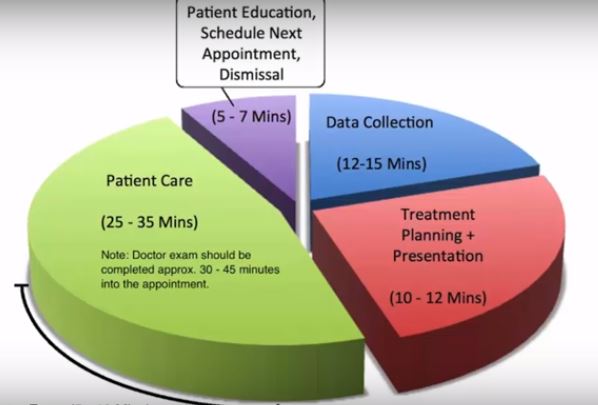
In Diagram A you will see our Time Management Formula which outlines where the hygienist should be during the hygiene appointment. This time management formula helps hygienist to find time to discuss what is seen in the patient’s.

The first part of every hygiene appointment will be the data collection. This will include not only the review of medical history but the perio exam, oral cancer exam, radiographs when necessary, a smile evaluation, visual exam, intra-oral photos.

After you collect all the important patient information you will sit the patient upright and knee-to-knee-eye-to-eye to now create a partnership with your patient to show them what you see. Now you are in the Treatment Planning phase of the hygiene patient appointment.

Please note: this time management formula is only a suggestion of time and if you have less than sixty minutes of time with your patient you will adjust the time formula so it meets your schedule. This is an example of time for the sixty minute hygiene appointment.

During this time with your patient you will show them what you see on their perio chart, radiographs and/or intra-oral photos. Let your patients be a part of what you see. Ask them to show you what they see after you show them. Say words like “bleeding, infection, large black area is tooth decay moving very close to the nerve which can cause you a toothache.”

Your patient is possibly hearing this information for the 1st time and all these words are new to their oral condition. It can feel overwhelming for your patient to hear all this information, so break it down into words you believe they will understand.

This means that you will not say words like “Periodontal Treatment” but instead you will say “Gum Treatment.” You do not want to say, “Deep Cleaning” because when a patient has gum disease (AKA: Periodontal Disease) this is not treated with a cleaning but with a special “gum treatment” or “gum therapy.” It also down-plays what is actually happening in their mouth. A periodontal patient is not going to get a cleaning.

Once the doctor enters to do the exam it is the hygienists’ role to connect them with the patient and guide them through what has occurred during the appointment.

The connection is an update your patient; a personal aspect of their life. This is rapport building. It doesn’t need to take but a minute for doctor to be reconnected with a routine patient.

With the hygienist’s guidance, when talking with doctor in front of the patient and doctor, the patient will hear the same words used to describe the patient’s oral condition.

Then when dismissing the patient, the hygienist will again explain to the front desk what was completed, what the patient needs to schedule for (if not scheduled in hygiene room) and the valuable “reason the patient will return.”

Now your patient has heard this topic of discussion, these words which describe their oral condition, at least 3 times and they are beginning to be more familiar plus have a deeper understanding of what is happening in their mouth. They are now understanding why it is important to return sooner than later.

This system is part of what we teach our clients (Our doctors and their team) which is helping to “close the back door.” This is what helps keep our client schedules full and productivity high.

  • Do you know what percentage of your treatment plans come from the hygienist showing the patient hat is happening in their mouth?
  • Do you know the specific words to use that will add a lot of value for your patients to schedule, pay and return to your office?

This is what we spend a lot of time working on with our clients.

Let us know how we can support your team and get you to that next level of success.

Contact Vanessa our VP of Client Relations to discover what your true potential is for 2017. Email: mail://vanessa@dentalpracticesolutions.com or O: 949-351-8741

We also have live CE Events that may help support your team to get to the next level.

See our events page: www.https://dentalpracticesolutions.com/events-courses/

Debbie Seidel-Bittke, RDH, BS One of Dentistry Today's Top Consultants

Debbie Seidel-Bittke, RDH, BS One of Dentistry Today’s Top Consultants

About Debbie

Debbie Seidel-Bittke, RDH, BS is an international dental consultant, coach, speaker and author. She is also CEO of Dental Hygiene Solutions, powered by Dental Practice Solutions. Debbie is a world-class leader in creating highly profitable hygiene departments. She is a well-known former clinical assistant professor at USC in Los Angeles and a former hygiene department program director. Dentistry Today recognizes Debbie as a Leader in Dental Consulting for the past 12 yrs.  No Cost Hygiene Dept Training Video Series. Grab it here Now. REGISTER FOR TRAINING

Posted in Business, Case Acceptance, Treatment Planning

Dental Appointments. Your Patient’s Reason to Return

By: admin

March 29, 2017

Dental Patients Reason to Return

Treatment Planning

How do you know what is valuable to your patient?

What is the benefit to your patient if they complete their dental treatment or return for their dental hygiene appointment routinely?

What is your patient’s reason to return?

Let’s think about when you will learn what is valuable to your patient.

When will you know what is valuable to your patient?

For new patients you will (or should) discover what is valuable to them during that first phone call to your office.

It is important to listen closely to the words your patient is saying and the way they say what they are saying. Do they speak loud or soft? Do they speak fast or slow? What is their tone as they speak?

Do they say things like, “Money is going to be my reason for completing this treatment I know I need.”

BTW: This is a comment from a walk-in new patient for an office (a client office) I was working with today.

Most of the time your patient will make their decision based on their value around time or money. These are the two main factors that come into play when patients are making a decision and it is your job to overcome these objections before they even are a stated objection.

Why many patients will not return to a dental office is due to fear of anxiety from a previous bad dental experience. This is another topic of conversation.

Patient Discovery 

When is the best time to discover what is valuable to your patient?

Answer: The first 2 minutes will be the most valuable time with building rapport and understanding your patients’ needs, what’s important to them and even how their day is going (ex: If they are rushed for time or having a stressful day!).

In fact, the first “Hello” and a handshake can tell you a lot about what kind of day your patient is having. This is where you can first begin to build (or re-establish) rapport.

This conversation can be as simple as “What are you doing this summer?”

If you were to ask me this question, I will tell you that I am going to an important high school reunion.

The topic of my conversation (If I am your patient today) will center around meeting up with old friends and wanting to look my best!

Now, it’s your turn as the clinician to open the door for me to look my best.

Do you have a special laser whitening offer going on?

YES?! 

Now is a great time to ask “Debbie, if there is one thing that we can do to make you look better than ever for you high school reunion, what would that be?”

Great question! And if I am your patient here is what I will tell you:

“I would love to have my teeth look youthful again. I want them whiter and also longer.”

Does your office have a special smile makeover process?

If so, now is a great time to talk about this process and how it can make me look my best for the summer high school reunion.

Complete the scheduled appointment, do an “initial” smile evaluation and then have me back for a 20 minute consultation later this week. At this consultation appointment you will have your treatment (or financial) coordinator discuss the smile makeover and work out the financial arrangements. Now you will schedule the treatment.

This special consult adds value to your patient appointment. The initial patient value you discovered is why this patient wants to return ASAP for the consultation and find out more information about how you can help her meet her needs.

Do you see how simple that can be to have your patient understand “their” important reason to return to your office?

When you think back to the last day of patients in your dental office, can you think about each patient’s personal reason to return to your office?

This is not a reason around what you “found” in their mouth. This important reason to return has to be a reason important to your patient. This is a value to your patient.

In closing today I want to ask you, “Do you know each patient’s important reason to return?”

We teach this system with our clients, their team and it becomes a part of every patient appointment. This is what we call the R2R and it becomes a part of each patients record.

One of Dentistry Today's top dental consultants

Debbie Seidel- Bittke, RDH, BS Dental Hygiene Consultant

           About Debbie

Debbie Seidel-Bittke, RDH, BS is an international dental consultant, coach, speaker and author. She is also CEO of Dental Hygiene Solutions, powered by Dental Practice Solutions. Debbie is a world-class leader in creating highly profitable hygiene departments. She is a well-known former clinical assistant professor at USC in Los Angeles and a former hygiene department program director. Dentistry Today recognizes Debbie as a Leader in Dental Consulting for the past 12 yrs.


Posted in Case Acceptance, Dental, Treatment Planning

Treatment Planning Creates Your Own Economy

By: admin

August 13, 2013
Treatment Planning Creates Your Own Economy


In today’s world of dentistry there seems to be a focus on what to present to patients and how to present it to patients. As a Dental Practice Management Consultant I am consistently asked “Debbie, how can I get more patients to…?” Today I will write about treatment planning and how to create your own economy.

Here is a small list to explain why dentists call to speak to me:

Dentists ask me about treatment planning and improving case acceptance.

  • Dentists ask how they can get an increase production numbers without working more
  • Dentists ask me how to get overdue hygiene patients back on the schedule
  • Dentists ask me now to get more patients to say YES to treatment plans
  • And so many more questions to keep their dental practice alive in today’s challenging economy!

Recently I posted this quote on Facebook. Not sure where I found it:

“Those who believe they can move mountains DO! Those who believe they can’t cannot. Belief triggers the power to do so. PERIOD.”

It is what I believe and what has come true in my life. PERIOD!
I hear dentists say “This economy…” My response to this is “Create your own economy.”

Treatment Planning Creates Your Own Economy

Let me preface this by telling you a story I recently heard about in the media.
This is a story about Oprah Winfrey. Many of you may not know who Oprah Winfrey is so let me explain briefly. Oprah Winfrey is s an American media proprietor, talk show host, actress, producer, and philanthropist. She is also African American. Last year she made 77 Million! (USD) YES! That much!

What does Oprah Winfrey have to do with treatment planning? Well…she was recently in the media because she attended Tina Turners wedding in Zurich, Switzerland. While she was in Switzerland she walked into a shop where a beautiful handbag caught her eye.

The handbag just happens to cost $40,000. When Oprah asked to see the handbag the clerk in the store told her “I am sorry but that handbag is too expensive for you.”

One more time she tried to ask the lady to see the handbag “No, really I just want to see that one.” The shop keeper told her “I don’t want to hurt your feelings” Oprah kindly and very politely told the shop keeper “You’re right, I can’t afford it.” Then she walked out of the shop.

So how does this relate to treatment planning? You may be asking “Why are you talking about this woman Oprah Winfrey?!”

My reason is because so many offices prior to working with me and/or my team, only talked to their patients about treatment they “thought” their patients could “afford”.

You may have read my story about this before. This is a fact: Many years ago I worked for a dentist (As a dental assistant) who looked out the window of one of the treatment rooms and he would check out what type of car the new patient arrived in. Then he would prepare what type of treatment plan he could present according to what type of car they were driving. Would he discuss a $200 (USD) treatment plan? Or would he present a $20,000 (USD) treatment plan? Well, I can tell you that most patients only heard about the $200 treatment plan.

This Oprah Winfrey story reminded me of this situation. AND today, I still hear dentists say “It is the economy that doesn’t allow me to present comprehensive care to my patients.”

I need to ask you:

  • Is it fair for you to pre-determine what type of care you will offer your patients?
  • Is it fair to base your treatment plan on what you “think” they can afford or what their response may possibly be?”
  • Can you honestly pre-determine what answer your patient will give you before you show them what is happening in their mouth?
  • What would your patients think if you didn’t tell them the truth about their disease or oral condition that may affect their health and enhance their appearance?
  • Is it fair to your patient to “look the other way” when you see disease, BOP, a missing tooth, etc?

Tell Them the Truth

Have you ever thought of NOT telling a patient about a necessary implant or veneer because you knew their insurance would not pay for it? What if you thought your patient could not afford the treatment you know needs to be completed – would you neglect telling them what they really need?

Maybe you told your patient you could do a 4 or 5 surface restoration instead of a crown thinking, “I know their insurance won’t pay for this so blah, blah, blah..”

Would you present the realy picture for a perfect smile and improved health if you knew it was your mother, your wife, your husband..? Why would you offer your patient something less?

I do hear these stories all the time!

  • How do you decide on a treatment plan?
  • Do you think that “This economic crisis is so bad I will only diagnose for single tooth dentistry?”

I know some of you will answer “YES” to this question. You believe that due to this economy you must go easy on your patients.

We do have an ethical obligation to tell our patients the whole truth and nothing but the truth.

That shop keeper didn’t believe Oprah Winfrey could afford a $40,000 handbag because of her appearance.

We must provide our patients with options. As healthcare providers we have a legal and ethical obligation. Please…leave the final decision up to tyour patient.

Let them decide what they can or can’t afford.

Most long-term patients establish great trust in their dentist. This is why your patients will say “YES” to your care. This is why you must tell them what really exits in their oral cavity.

Your patients are depending on you to tell them what they really need. They deserve to hear all their options.

When they buy a car I promise you they want to know if the sun roof is included and they will decide for themself if they want to Sirus Audio System included. And many will pay extra for it!

What Can We Learn From Oprah Winfrey?

You see, this was not the first time a shop keeper turned Oprah Winfrey away. The first person many years ago flat out told her they would not sell to her because her skin was black.

In Switzerland, most people have never heard of Oprah Winfrey and the shop keeper, who told her she didn’t want to hurt her feelings but she couldn’t afford that handbag, obviously didn’t know who Oprah was!

And how do you think that shop keeper feels now knowing that the billionaire woman was refused service in her shop? There has been an official apology as well as the Swiss government apologizing.

And how many of your patients have you neglected to tell exactly what type of dentistry they needed?

Did you tell them their options for that missing tooth? Did you allow your patient to decide which is best for their pocketbook?

  • Build trust with your new dental patients — at their first appointment

 “Customer is king”

  • Treat every patient the same (provide a specific level of care for all patients of record.

  “Every patient deserves to know what is going on inside their mouth and the various options that can create health and even a more beautiful smile”

  • Allow all patients to know the types of dental treatment options you can offer patients
  • Allow patients to know and truly understand that you care about their well-being

 ” People don’t care how much you know but they do want to know how much you care”

  • Tell patients what you see in their mouth

“Many patients believe the dentist will FIND something. Change this into a conversation of “co-diagnosis”. This means that your patient participates looking with you. (use a hand mirror or intra-oral camera) Show patients what you see and tell them “This is what we see in this area on your lower right area.” (Identify where you are looking in their mouth – especially when using an intra-oral camera)

  • Provide patients with options to create health and a longer life (And many want to look more beautiful as they age)

                       “Most people do want to live a longer and healthier life!”

People Buy What They Want

  • I can tell you that people really do buy what they want.
  • If you present a benefit for placing an implant over a removable appliance or doing nothing, at least you have left the choice up to your patient.
  • If you position yourself, speak with a certain (Caring, etc.) tone and in a manner that you know are comfortable with your patient, they are more likely to trust you and believe that you have their best interest in mind.
  • When people know how much you care and when they trust that you have their best interest in mind, the decision to say “YES” and accept your treatment plan becomes so much easier for everyone.

Recently, I spent some time in Palm Desert, California. It is summer time and the snow birds (The retired people) have returned to their other home. This beautiful desert location was still filled with a lot of people. They temperatures were triple digits. (Temperature in Fahrenheit) There were so many families in the desert vacationing with their families. These families didn’t drive in old beat up cars but nice, big, expensive cars. The families were in the restaurants’ and shops.

I also noticed that the car dealerships were plentiful. I saw dealerships for such automobiles like: Bentley, Jaguar, Mercedes, BMW, Cadillac, etc., etc.

There were dental offices on every corner. And the dental offices I visited were very upscale.

In Conclusion

I know for sure that people are spending money. I spoke to a retired lady I know today about this. She constantly tells me she needs to watch her money. But when I asked her if she would stop spending the thousands of dollars each year on her face creams she quickly told me “Absolutely not!”

I know that if you understand how to effectively communicate with your patients and if you know when to be quiet and listen, if you understand how to build trust with your patients – You will have many more patients say “YES” to your care.

I am interested to hear how you create a treatment plan in today’s world. I want to know what type of economy you are creating for yourself.

How do you create your own economy? What are you doing during the dental patient appointment to build trust? How do you explain all the options to your patients? How do you know you don’t have an “Oprah Winfrey” sitting in your dental chair?

I would like to hear about your experience with treatment planning and how you deliver your message today. Do you discuss single tooth dentistry or comprehensive dental care options?

What you believe really is what you create. The words that come out of your mouth do become YOUR reality.

Tell me more about your world – your economy –  in the comment section below.

 About Debbie

ME not too high jpeg

Debbie Seidel-Bittke, RDH, BS is founder of Dental Practice Solutions, and has successfully designed efficient dental hygiene departments that result in high performance dental teams for over 13 years. Her focus is providing optimal patient health while consistently increasing profits for the dental practice.

Debbie is an accomplished author who speaks internationally about her signature systems and services for the dental hygiene department. She utilizes the most recent science and research to prevent disease while increasing the teams’ enthusiasm and guiding the dental team to consistently increase profits.

In 1984 she graduated from the University of Southern California (USC) in Los Angeles, California with a Bachelors Degree in Dental Hygiene. She is a former clinical assistant professor from USC in Los Angeles, CA. In 2000-2002 Debbie co-taught the practice management course for the dental students at USC. Debbie is also a former dental hygiene program director for a school in Portland, Oregon where she wrote the accreditation, hired the teachers, purchased equipment and managed a 2 million dollar budget.

Debbie works with dental practices throughout the world implementing her signature dental hygiene systems and is considered one of the Top Leaders in Consulting for Dentistry Today. She can be reached at: www.https://dentalpracticesolutions.com, support@dentalpracticesolutions.com or call: 888-816-1511.


Posted in Uncategorized

Dental Practice Management Consultant Takes Team from Good to Great!

By: admin

August 6, 2013

factoria-dentistry-staff-home

As a Dental Practice Management Consultant I see various types of dental practices.

It is the sad truth but most of the dentists who contact my office are usually at a sink or swim stage and it can be a daunting task to even pick up the phone and talk,  let alone try to make a decision about hiring a dental practice management consultant.

(And this article will explain the ROI on hiring a consultant.– IF you read between the lines regarding their BIG results!)

It usually takes a dentist 3 months to make a decision to hire a new consultant and by this time the office numbers have plummeted to where doctor is not able to sleep at night.

Does this sound like you? Are you one of these dentists thinking that you must do something but you fear change or worse, you fear nothing will ever change no matter what you do!

“Insanity: doing the same thing over and over again and expecting different results.” ~ Albert Einstein 

Maybe you have tried various new dental business systems or other practice management programs and nothing seems to work.

Let me put your mind at ease and begin to share a recent client of ours: (Read on and you can calculate for yourself the doctors ROI on hiring a Dental Practice Management Consultant)

In order to create consistent profitability for doctors desired outcome I needed to  research and  analyse their current numbers. I looked at their list of services, fees, production and collection numbers, P & L, etc., before we began to dive into the consulting process. We were able to set realistic goals after sitting down to research and strategize together.

Years ago, I learned that it is extremely important to identify the practices’ obstacles and road blocks, to reach where they want to be. Once I have the attention of doctor and the team I can place my full attention, together, with my passion, enthusiasm and keen insight, to dig into the necessary work that needs to be done. We create a step-by-step process to work smarter and not so hard. It really doesn’t not mean that working with a Dental Practice Management Consultant is stressful or creates more work. It is just the opposite.  Together; doctor, the entire team and I, roll up our sleeves and dig deep into the barriers that broke down the success of the office.

Big Results

The team at “Dr. XYZ” in Portland, Oregon, has shown big improvements in less than 5 months of hygiene department coaching. When I first met with doctor she showed me the hygiene schedules. Each hygienist (2 hygienists) had at least 2 openings each day. The office has seven days of hygiene patients each week. Originally these days were not booked with patients but just sitting open.

The entire team changed many of the words that they used with their patients. The front office scheduling coordinator no longer calls and asks patients to return a confirmation call. She is confirming patients appointments about 4 days in advance of their appointment. All patients are now aked if they prefer to be contacted via email, text message or phone call.

(Some of the words they changed were “Cleaning” as well as asking patients when THEY wanted to return vs. suggesting an appointment date and time. They took control of the schedule. AND they increased the percentage of pre-scheduled hygiene patients.)

Many of the patients now request an email to confirm their appointment. The email says something like this:

“Dear Mary,

I am writing to let you know that Doctor XYZ and Holly, (Most know HOLLY is their hygienist) are looking forward to seeing you for your preventive care appointment. Dr. XYZ will review your x-rays and complete a visual exam. Holly will also complete an oral cancer screening exam using our new technology called Vizilite with can detect any early signs of oral cancer. She will also evaluate the health of your gums for inflammation, disease, check any restorations, remove plaque, calculus and stains as necessary. We look forward to seeing you on Friday August 9th at 8 am.”

In good health,

Megan Ridgley
Scheduling Coordinator at Dr. XYZ

Here are the BOTTOM LINE Results the office has received from the Dental Practice Management Consulting Process:

  • The office of XYZ has decreased their cancellations and open holes in the hygiene schedule, down to no more than 1 each week.
  • The team began role-play exercises to more effectively communicate non-surgical perio treatment. We also worked together (role-play) on overcoming many of the barriers and obstacles for patients accepting aesthetic and restorative treatment.
  • The original percentage of adult  patients treated for periodontal disease went from 18 – 45% in the past five months.
  • The hygienists now have a 90% acceptance rate for using the Vizilite which has contributed to an increase in production.
  • The team learned how to assess and categorize patients for Caries Risk using the most recent CAMBRA protocols. (found in California Dental Journal 2011) This provided another $3,000 production to the practice without creating more patient time in the chair and didn’t increase the practice’s overhead. This is pure profit!
  • This increased hygiene production as well without adding more chair time or hiring more employees to work in the office.

One Team Challenge Existed

The one challenge they were still having at the end of July was keeping the hygienists on time so we were able to implement our “Down to a Science” strategy which seems to be helping with time management.

The Dental Practice Management Consulting Process

  • Each month I have at least one phone call with doctor to discuss the successes and challenges that may still exist. We are able to work together to create a systematic approach to solve these challenges as they occur.
  • Every sixty days myself or one of my team coaches is in their office for about 1 1/2 days of hands-on training, team meetings, role-playing and strategy sessions so discover solutions to any challenges.

The fact that the team has an expert there to guide them through a step-by-step process is a much easier way to create their next stage of success.
I have to add that the office administrator is great to work with and we spend a lot of time working together each week.

As of August 5, 2014 the office production numbers are at $628,000 with the hygiene department up by $65,000 and aesthetic/restorative case acceptance has increased by $110,000 this year so far.
The total production and collections is estimated to be up by approximately 30% from 2012.

More Big Team Results

The team has gained a new enthusiasm for working together. They told me that they feel like a family and have their friends (their patients) come to visit daily.

Recently, doctor had a pizza party after hours and each team member played a role in calling overdue hygiene patients. This was one more solutions we came up with through our research and strategy sessions together.

The team also receives a bonus when they achieve their new collection goals which appears to have limited team morale.

Would you like to be our next success story? There are so many options today. The one roadblock I see holding offices back is the attitude “It’s this economy that holds us back!” I want to say to you “Creaate your own economy!” People really are finding many ways to buy what they really want. Do your patients understand the wonderful menu of services you offer?

Does you team educate your patients about doctors extensive specialty courses he/she has completed?
Let your patients know about the research on oral health and it’s relationship to total health. I do believe most of your patients want to live a longer health status.

Let’s schedule a time to talk about your next level of success: support@dentalpracticesolutions.com or 888-816-1511
Maybe you want to take a test drive of what our team offers. Here is a simple and a simple step-by-step guide to get your started:
30 Day Dental Hygiene Profits Program

ABOUT DEBBIE

ME not too high jpeg

Are you looking to improve profits in your dental hygiene department? Debbie has an innovative and successful way to educate you and your team to create the small tweaks mentioned in this blog. Debbie has been in the trenches of the dental office over 30 years. She is a former Dental Hygiene Program Director, an assistant professor from the University of Southern California and even co-taught the practice management course for the senior dental students at USC.

Check our her services section on the website to find one that meets your needs. Consider getting your team involved in her 12 week Case Acceptance Program. You won’t need to stop your day of work at the office or pay for a consultant to travel to your office. The program is at your fingertips 24/7  indefinitely.

Debbie speaks at most of the major dental conferences in the world. She is recognized for the past 8 years as “One of Dentistry Today’s Top Consultants.”

She will also be featured on the cover of Hygiene Today in September 2013. (Published alongside Dentistry Today)

Many of her clients span from not only the United States but Brazil, Australia, India and the UK, just to mention a few.


Posted in Uncategorized

Post navigation

  • ← Older posts
  • Newer posts →

Return to Your Training Vault

Contact Info

  • 15508 W. Bell Road Suite 101 PMB 431, Surprise, AZ 85374
  • (623) 252-1941
  • admin@dentalpracticesolutions.com

Office Hours

  • Mon-Thu 8:00am - 5:00pm PST
  • Friday 8:00am - 2:00pm PST

Useful Links

  • Home
  • About
  • Sitemap
  • Terms of Use
  • Privacy Policy

Recent PR

  • PrestoSmile® and Dental Practice
  • Dental Practice Solutions - Debbie Bittke
  • Dental Practice Solutions - Debbie Bittke
  • Dentistry Leaders
Copyright 2026 Dental Practice Solutions

    Input this code: captcha

    captcha

    • Home
    • About
      ▲
      • About Us
      • Testimonials
      • Videos
    • Services
      ▲
      • Hire a Dental Hygienist
      • Dental Hygiene MAX Course
      • 6-Month Dental Hygiene Department Optimization
      • 12- Month Dental Hygiene Department Training
      • Dental Hygiene Department / Team Workshop
    • E-Learning
      ▲
      • Free Resources
        ▲
        • BOOST CASE ACCEPTANCE eBook
        • Treating the Gingivitis Patient
      • More Courses
        ▲
        • Oral Inflammation and Systemic Vitality
        • Properly Sequence Hygiene Appointments
        • Alzheimer’s Disease Prevention.
    • Webinar
      ▲
      • Current Webinar
      • Power Hour March 15 2024
    • Blog
      ▲
      • Podcasts
    • Contact Us

    Schedule your free coaching call here client login

    (888) 816-1511

    Introduction to Orientation Video Part 1